
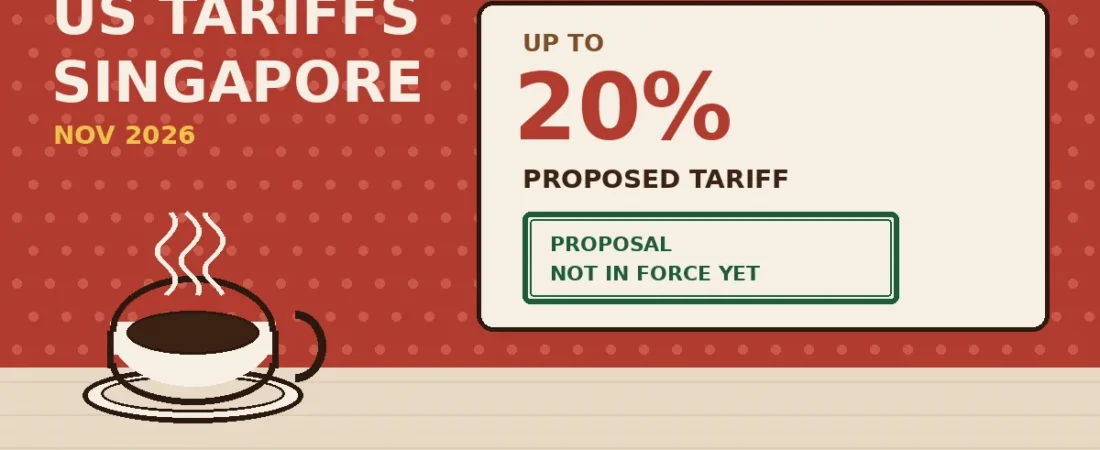
The United States has proposed new duties after a Section 301 investigation into what it calls structural excess manufacturing capacity. The proposed US tariffs on Singapore are of up to 20%, with a possible 10% rate if a reciprocal trade agreement is reached. They are not in force yet.
USTR published the determination on 25 November 2026, already 26 November morning in Singapore. Here is what the proposal says, why Singapore was named, how local markets moved on Wednesday, and what a long-term retail investor might consider. Educational only, not financial advice.
Table of Contents
☕ Quick Answer
USTR has proposed US tariffs on Singapore of up to 20% on all goods, net of existing Section 301 tariffs, with exemptions for certain goods. The rate could fall to 10% if Singapore reaches a reciprocal trade agreement, or concludes other talks that address the findings. Comments are due by 5 January 2027; hearings begin on 25 January 2027. As of this morning, 26 November 2026, the METI newsroom had not published a new statement on this determination.
What the Proposed US Tariffs on Singapore Include
On 25 November, USTR determined that the acts, policies and practices of 14 economies relating to structural excess capacity in manufacturing are “unreasonable and burden or restrict U.S. commerce”, and are therefore actionable under Section 301(b). Singapore is among those named, alongside China, the EU, Japan, Korea, Taiwan, India and several ASEAN partners. Mexico and Norway were not determined at this time.
For Singapore, USTR proposes “to consider applying tariffs of up to 20 percent, net of existing Section 301 tariffs, on all goods of Singapore, with exemptions for certain goods,” and “to consider adjusting the tariff rate applied to each good to 10 percent” if Singapore reaches an Agreement on Reciprocal Trade, or other negotiations “responsive to the determinations in this investigation”.
“Net of existing Section 301 tariffs” matters because Singapore already faces a separate 12.5% Section 301 duty on some exports, from a different forced-labour investigation. MTI said on 24 July 2026 that about one-third of Singapore’s domestic exports to the US would be affected, from 12.01am Eastern Time that day. On 8 September 2026, Deputy Prime Minister Gan Kim Yong put the exposure at about S$9.5 billion a year, or about 3% of total domestic exports. The Business Times, citing a senior US official on 25 November, reported that the new proposed duties “would not stack on top of” the July 10% or 12.5% tariffs.
In short, the proposed US tariffs on Singapore are a plan for public comment, not a duty already charged at the US border.
When Could Any Tariff Take Effect?
USTR initiated the investigations on 11 March 2026. Comments and hearing requests are due by 5 January 2027. Public hearings begin at 10am on 25 January 2027 at the US International Trade Commission in Washington, “continuing, as appropriate”. Until a final action is published, US tariffs on Singapore remain a proposal. A senior US official told The Business Times this “could push implementation into January”, which is an expectation, not a start date.
Why Was Singapore Named?
USTR’s published case for US tariffs on Singapore cites industrial plans, financial repression, savings-promotion policies, labour protections, support for key sectors, and a failure to address global excess capacity, including through imports and investment from non-market economies. It says this is “especially true in sectors like electronics and semiconductors, health, and petrochemicals.”
Singapore has already set out a different view. In official comments dated 15 April 2026, the Government said the US “has enjoyed a consistent trade surplus with Singapore for over 20 years.” Citing the US Bureau of Economic Analysis, it reported goods and services surpluses of US$3.6 billion and US$29.6 billion in 2025, up from US$1.9 billion and US$25.1 billion in 2024. It concluded that “Singapore’s exports to the U.S. are not due to any form of excess capacity,” and added: “We look forward to engaging the U.S. further on this issue.” I checked the METI newsroom on the morning of 26 November 2026 and found no new official media statement on this determination. The latest items were dated 24 November and covered other subjects.
How the STI, Banks and Exporters Moved on Wednesday
News of the proposed US tariffs on Singapore arrived during an AI-related sell-off, which I covered in the AI stock sell-off post.
Lianhe Zaobao reported that the Straits Times Index fell 0.57%, or 28.04 points, to close at 4,930.83 on Wednesday, 25 November. Singtel led STI gainers, up 1.94% to S$4.21. Seatrium was the weakest constituent, down 4.23% to S$1.36; The Business Times noted that drop followed a retrenchment announcement a day earlier. The local banks all closed lower: DBS at S$65.44 (−1.2%), OCBC at S$26.38 (−0.9%) and UOB at S$35.20 (−0.2%). AEM fell 6.8% to S$5.79. Lianhe Zaobao later reported that UMS Integration and Nanofilm Technologies both lost more than 3%, while Seoul fell 6.16% and Taiwan 4.80%.
Adeline Gao Yuanhui of FSM Global told Lianhe Zaobao that higher tariffs would “inevitably weaken the competitiveness of Singapore’s export sector, particularly electronics”, depending on final rates and coverage. That is an analyst’s view, not advice.
What a Long-Term Retail Investor Might Consider
A headline about US tariffs on Singapore can make a portfolio feel concentrated in trade, banks or technology. A proposal is still not a reason to panic-sell.
- Concentration. How much sits in a few exporters, semiconductor names, or a single country? Diversification can reduce the impact of any one shock. See the guide to investing in Singapore.
- Overlap. US AI or chip funds now sit on top of the recent AI stock sell-off.
- Near-term cash. Money needed soon is usually better kept as cash. See the SSB vs T-bill guide.
- Process, not a tip. Regular investing and occasional rebalancing are possible approaches. They do not guarantee a profit or recommend buying the dip.
Emergency cash, time horizon and risk tolerance matter more than any one announcement.
What to Watch Next
The next hard dates are 5 January 2027, when comments are due, and 25 January 2027, when hearings begin. Also watch for any official METI statement, talks on a reciprocal trade agreement, and the final product list if a measure is confirmed. Until a final action is published, US tariffs on Singapore are still only proposed. The Federal Reserve’s 8–9 December meeting is a separate watchpoint, after October PCE of 3.8% and core PCE of 3.3%.
US Tariffs on Singapore FAQ
Are the US Tariffs on Singapore Already Being Charged?
No. The US tariffs on Singapore are not being charged yet. This is a proposed action for comment.
Would Every Singapore Export Face a 20% Tariff?
Not on the face of the proposal. USTR proposed tariffs of up to 20% on all goods of Singapore, with exemptions for certain goods, a possible 10% rate if a deal is reached, and a rate net of existing Section 301 tariffs. Final coverage, if any, will be set later.
Has the Singapore Government Responded?
Not with a new METI newsroom statement, as of the morning of 26 November 2026. Official comments dated 15 April 2026 rejected the excess-capacity claim and said Singapore looked forward to further engagement with the US.
Should I Sell Singapore Stocks or US Holdings Now?
That depends on your goals, time horizon and risk tolerance, not on a headline alone. Panic-selling locks in today’s price. This is not a recommendation to buy, sell or hold anything. Speak to a licensed financial adviser if you need personal advice.
Sources
- USTR press release — determinations and proposed actions, 25 Nov 2026
- USTR — Singapore Federal Register notice, comments due 5 Jan 2027, hearings 25 Jan 2027
- METI — Singapore Government written comments on the excess-capacity investigation, 15 Apr 2026
- METI newsroom — checked on the morning of 26 Nov 2026; no new statement on this determination
- MTI — media statement on the separate 12.5% forced-labour Section 301 tariff, 24 Jul 2026
- METI — oral reply by DPM Gan Kim Yong, 8 Sep 2026
- Lianhe Zaobao — STI close, 25 Nov 2026, 6.12pm SGT
- Lianhe Zaobao — regional markets and analyst comments, 25 Nov 2026, 11.46pm SGT
- The Business Times — STI, banks and AEM, 25 Nov 2026, 6.07pm SGT
- The Business Times — USTR proposal and senior US official comments, 25 Nov 2026
- US Bureau of Economic Analysis — Personal Income and Outlays, October 2026, 25 Nov 2026
Source check: 26 November 2026, morning SGT. Stock closes are for Wednesday, 25 November. No new METI statement on this determination was found. No affiliate links.
Not financial advice. This post is for general education only, not licensed financial advice. Nothing here is a recommendation to buy, sell or hold any product. Investments can lose value, including your capital. Consider your own goals and risk tolerance, or speak to a licensed financial adviser, before you invest.