
When I first opened my IBKR Singapore account, I spent an embarrassing number of evenings just staring at the sign-up form. Not because it was hard — but because IBKR gives you so many options upfront (account type, base currency, trading permissions) that it feels like you’re being asked to make decisions before you even understand the questions.
A few years and a few hundred trades later, IBKR is still the account I use for the core of my portfolio. This IBKR Singapore review is the honest version of why — including the parts that annoyed me at the start.
What IBKR Singapore Actually Is
Interactive Brokers is a US-founded global brokerage that gives Singapore investors access to well over a hundred markets worldwide from a single account — US stocks, SGX counters, Hong Kong shares, European exchanges, ETFs, options, and more. For someone building a globally diversified portfolio (think VWRA, CSPX, SMH, or individual US names like NVDA and TSM), that single-account access is the entire draw.
The trade-off is that IBKR was built for people who already know what they’re doing. It’s not as friendly-looking as apps like Tiger Brokers or moomoo, and the interface has a reputation — deserved — for feeling like a professional trading terminal rather than a consumer app.
What It Costs to Use
This is where IBKR usually wins people over once they get past the interface. There’s no account minimum and no monthly or inactivity fee to hold the account open — you can fund it with a small amount and simply let it sit if needed.
For Singapore-listed stocks, commissions work out to roughly 0.08% of trade value, with a small minimum per trade. US-listed stocks and ETFs are priced per share with a very low minimum per order, and IBKR’s own Singapore pricing page confirms that Singapore retail investors can also access the simplified Lite pricing tier for commission-free US stock and ETF trades, alongside the more flexible Pro tier that most active investors end up choosing for better order routing.
Compare that to a typical full-service broker, and the difference compounds. On a modest monthly investment into US-listed ETFs, you’re often looking at a few dollars a year in commissions on IBKR versus tens of dollars elsewhere. Over a 12-year DCA plan, that gap adds up to real money that stays invested instead of leaking out in fees.
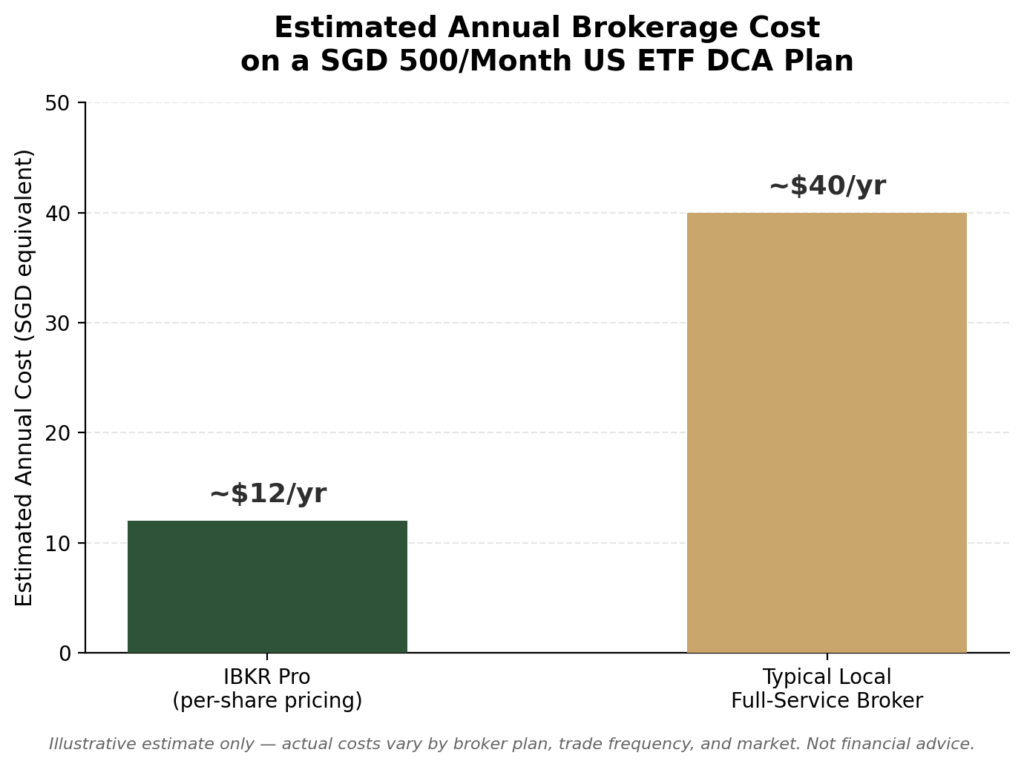
Illustrative estimate on a SGD 500/month US ETF DCA plan — actual costs vary by broker, plan, and trading frequency.
Where IBKR Falls Short for Beginners
I won’t pretend the platform is beginner-friendly, because it isn’t.
- The interface is dense. Trader Workstation (TWS) is built for people who trade often. If you’re doing simple monthly ETF purchases, you’ll likely live in the simpler mobile app or GlobalTrader instead — which is the right call for most people starting out.
- Options and permissions are confusing. IBKR groups trading permissions into levels, and the naming doesn’t always match what you’d expect from other brokers or general investing content online. If you ever move into options trading, budget time to actually read IBKR’s own permission descriptions rather than assuming.
- Onboarding takes longer than a fintech app. Account opening involves more verification steps than a two-minute mobile sign-up. It’s worth it for what you get, but don’t expect instant access.
Who IBKR Is Actually Built For
Based on my own experience, IBKR makes the most sense if:
- You want one account for both US and Singapore markets, instead of juggling multiple apps
- You’re investing for the long term and care more about low ongoing costs than a slick interface
- You’re comfortable spending a weekend learning the platform once, in exchange for years of low fees after that
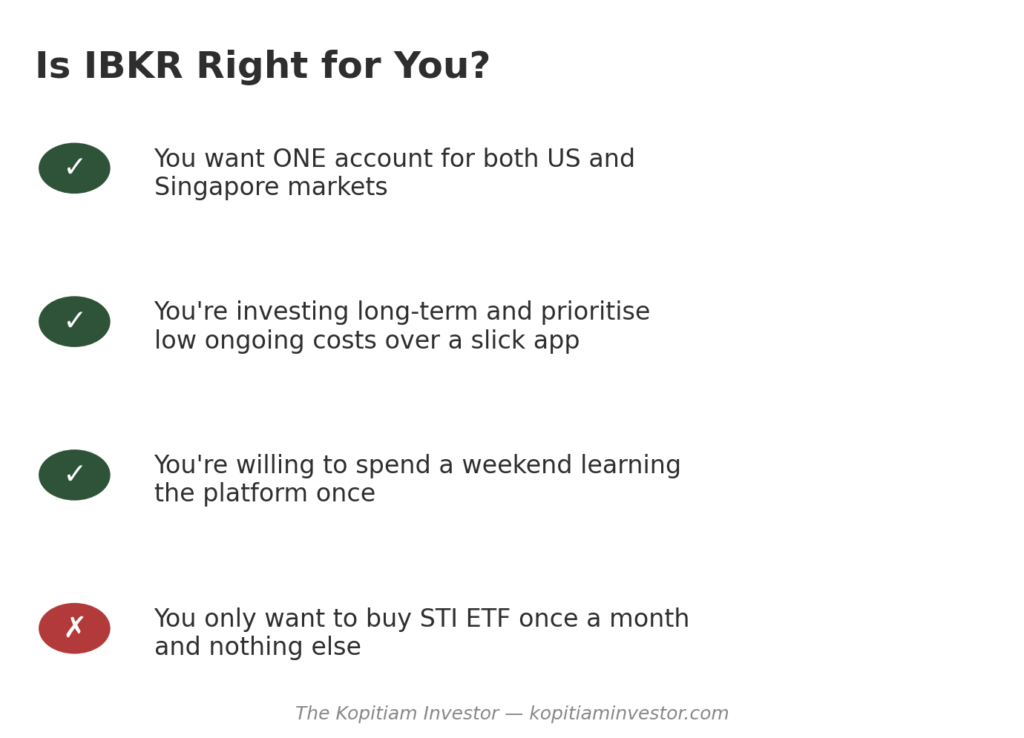
If you just want to buy STI ETF once a month and nothing else, a simpler local platform might genuinely serve you better — and that’s a fair choice. IBKR’s advantage only shows up once your holdings start spanning multiple markets and asset types, which is exactly where my own portfolio has ended up.
My Honest Verdict
So to wrap up this IBKR Singapore review: three-plus years in, IBKR remains the backbone of my portfolio — not because it’s the friendliest platform, but because the combination of low costs and genuinely global access is hard to match once you’re managing a serious long-term plan. The learning curve is real, but it’s a one-time cost. The fee savings are recurring, for as long as you invest.
If you’re serious about the kind of 10-plus year investing journey this blog is built around, I’d still tell you to push through the awkward first few weeks with IBKR. It gets easier, and the account grows with you as your strategy does.
Next up: How to actually open your IBKR account in Singapore, step by step — including the parts nobody warns you about.
Internal links to add:
- What is VWRA? The Lazy Investor’s Best Friend (Article 2)
- How to Start Investing in Singapore with SGD 100 (Article 1)