
Every Singaporean investor eventually asks the same CPF OA investing Singapore question over kopi: my CPF Ordinary Account is sitting there earning 2.5% — should I invest it instead?
This CPF OA investing Singapore question sounds simple, but it’s actually one of the trickier decisions in Singapore personal finance, because your OA isn’t just an investment account. It’s your housing fund, your safety net, and part of your retirement plan, all rolled into one.
Let’s break down what CPFIS actually is, what your OA really earns, and when investing it genuinely makes sense.
What Is CPFIS? CPF OA Investing Singapore Explained
CPFIS (CPF Investment Scheme) lets you use part of your Ordinary Account and Special Account savings to invest in approved instruments — Singapore-listed stocks, ETFs (like the STI ETF), unit trusts, bonds, and select insurance products.
The idea is simple: if you believe you can earn more than what CPF pays you in guaranteed interest, CPFIS gives you that option.
But there are real constraints most people don’t fully appreciate until they’re already in it.
What Does Your CPF Actually Earn?
Before deciding whether to invest, you need to know exactly what you’re giving up.
As of 2026:
- First S$20,000 in your OA earns an extra 1% bonus interest, bringing it to 3.5% per annum
- The rest of your OA earns the base rate of 2.5% per annum
- Special, MediSave, and Retirement Account (SMRA) savings earn 4% per annum
These rates are backed by the Singapore Government and reviewed quarterly — but the floor rates (2.5% for OA, 4% for SMRA) have been extended through the rest of 2026, so they’re not going anywhere soon.
Here’s the chart that makes it click:
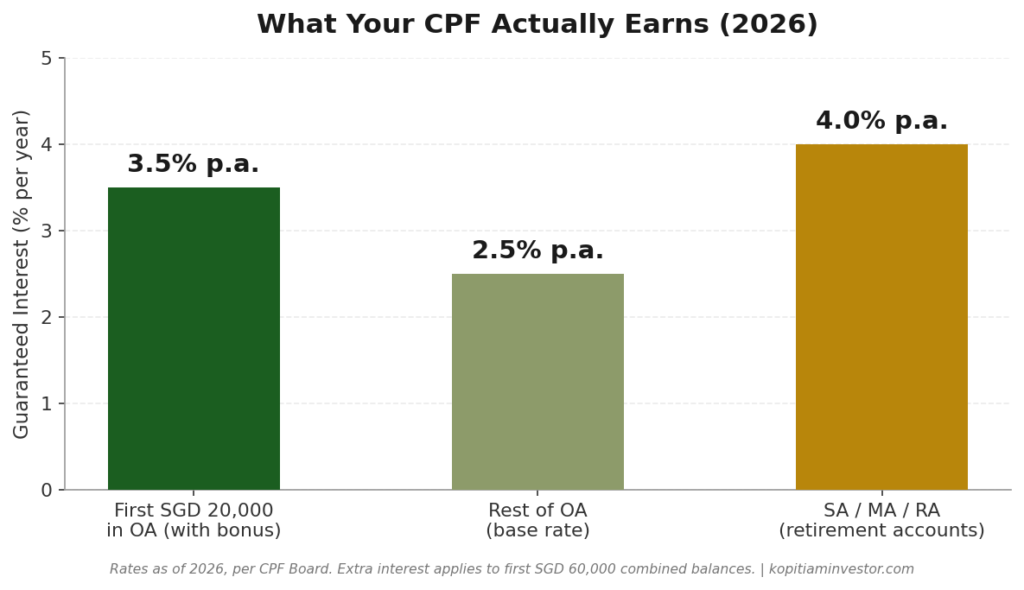
That 2.5-3.5% guaranteed, risk-free return is genuinely hard to beat once you account for the fact that CPFIS investing isn’t free.
The Hidden Costs of CPF OA Investing
This is the part most guides gloss over.
Sales charges. Unit trusts under CPFIS often carry upfront sales charges of 1-3%. That’s a chunk taken off the top before your money even starts working.
Agent fees and platform fees. Some CPFIS-approved products come with ongoing management fees that eat into returns year after year.
The 35% cap. You can only invest up to 35% of your investible OA savings (after setting aside the first S$20,000, which cannot be invested at all). This isn’t a small print detail — it fundamentally limits how much of your CPF can even participate.
Opportunity cost of guaranteed returns. Every dollar you move out of OA is a dollar that stops earning that guaranteed 2.5-3.5%. If your investment underperforms — even by a little — you’d have been better off doing nothing.
When Investing Your CPF-OA Actually Makes Sense
I’m not against CPFIS. But it only makes sense in specific situations:
You have a long time horizon. CPFIS investing needs years, not months, to overcome fees and beat the guaranteed rate. If you’re using this money for a house purchase in two years, don’t touch it.
You’re investing in low-cost instruments. The STI ETF (ES3 or G3B) through CPFIS has among the lowest fee structures available under the scheme. Steer clear of unit trusts with heavy sales charges unless you’ve done the math.
You already have a solid cash buffer outside CPF. Your OA isn’t meant to be your emergency fund. If investing your OA would leave you without liquid savings elsewhere, don’t do it.
Your expected returns clearly beat 2.5-4% after fees. Not “might beat it.” Clearly beat it, after accounting for sales charges and platform fees, over a multi-year horizon.
When You Should Just Leave It Alone
Honestly? For most people starting out, the answer is: don’t invest your CPF-OA yet.
If you haven’t started building your own separate investment portfolio outside CPF (through IBKR, for example, investing in something like VWRA), that should come first. Your CPF savings are already growing at a guaranteed, government-backed rate that beats most fixed deposits and many bonds.
The math only tips in favour of CPFIS once you’re a more experienced investor with a portfolio outside CPF, a clear multi-year horizon, and access to low-cost instruments.
My Honest Take
I haven’t moved my own CPF-OA investing Singapore into CPFIS — not because it’s a bad tool, but because the guaranteed 2.5-4% with zero fees and zero effort is already doing quiet, reliable work in the background. My focus goes into my IBKR portfolio instead, where I have full control over costs and instrument choice.
CPF OA investing isn’t wrong. It’s just not the first lever most people should pull.
This article is for informational purposes only and does not constitute financial advice. CPF rates and CPFIS rules can change — always check the official CPF Board website for the latest figures before making decisions.
- How to Start Investing in Singapore with SGD 100
- What is VWRA? The Lazy Investor’s Best Friend
- IBKR Singapore Review 2026: Is It Worth It?